You want your paperback orderable by bookstores and libraries, and the decision usually comes down to KDP Expanded Distribution vs IngramSpark. Expanded Distribution is one setting inside Amazon KDP, and enabling it pays you 40% of your list price minus printing costs, as of November 2026. IngramSpark is a separate account with its own upload, and its pricing page publishes no print royalty rate at all.
What Is the Difference Between KDP Expanded Distribution and IngramSpark?
KDP Expanded Distribution is a setting you enable on a paperback already published through Amazon KDP, which offers that book through distribution channels beyond Amazon's own marketplaces. IngramSpark is a separate print on demand platform, meaning a copy gets manufactured only after a customer orders it.
Two terms matter before you compare them. Your list price is the price you type into KDP's pricing page, and Amazon uses it both to list the book and to calculate what you earn. A wholesale channel is any retailer or library supplier that buys at a discount and resells, which is why both routes pay less per copy than a direct Amazon sale.
The practical difference is where the work sits. Expanded Distribution is a checkbox on a book you have already set up. IngramSpark means a second account, a second upload and a second set of files to keep in sync. IngramSpark's pricing page says signing up and uploading a print book or ebook costs you nothing, and that every book published through it gets global book distribution.
How Much Do You Earn Per Copy on Each Route?
KDP pays 50% or 60% of your paperback's list price minus printing costs on Amazon marketplaces, and 40% of list price minus printing costs through Expanded Distribution, as of November 2026. IngramSpark's pricing page publishes no print royalty rate.
Which Amazon rate you get depends on your list price. On KDP's paperback royalty page, the 50% rate applies to list prices at or below 9.98 USD on Amazon.com and the 60% rate to prices at or above 9.99 USD. The threshold moves by marketplace: 7.98 and 7.99 GBP on Amazon.co.uk, and 13.98 and 13.99 AUD on Amazon.com.au.
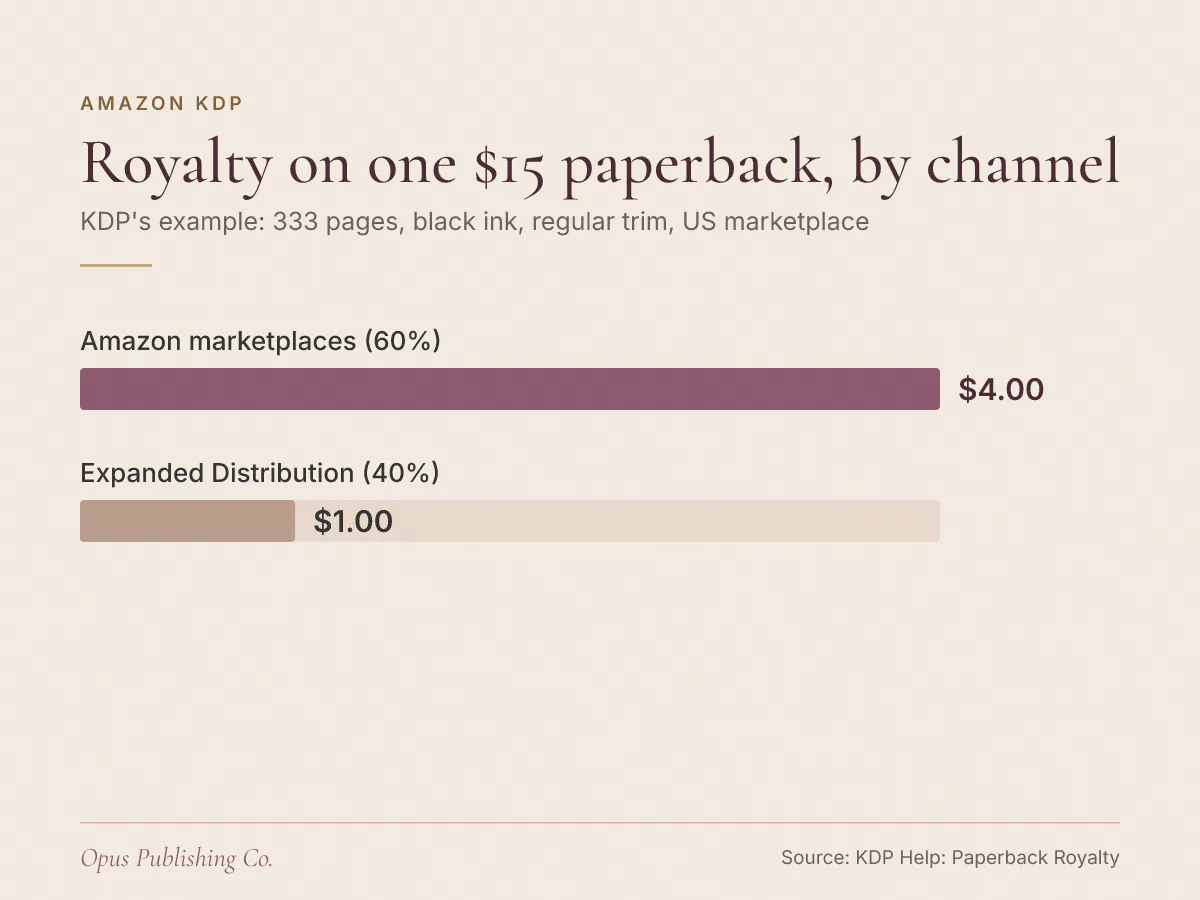
KDP's own worked example makes the gap concrete. For a 333-page regular trim paperback with black ink, listed at $15 and sold on the US marketplace, the Amazon royalty is (0.60 x $15) minus $5.00 of printing cost, which equals $4.00. The same sale through an Expanded Distribution channel is (0.40 x $15) minus $5.00, which equals $1.00. Same book, same price, a quarter of the money.
The 85% figure is an ebook rate, not a print rate
Comparison pages often put IngramSpark's "85%" next to KDP's 40% as though they measure the same thing. They do not. On IngramSpark's pricing page, the 85% of net revenue received by IngramSpark sits under ebook royalties, and net revenue is what IngramSpark receives from the retailer, not your list price. For print, that page gives no rate and sends you to its Compensation Calculator instead.
| What you are comparing | KDP on Amazon | KDP Expanded Distribution | IngramSpark |
|---|---|---|---|
| Print royalty rate | 50% or 60% of list price minus printing cost | 40% of list price minus printing cost | Not published; the page points to its Compensation Calculator |
| Royalty on KDP's $15 example | $4.00 | $1.00 | Not published |
| Ebook rate stated on the page | Not stated | Not stated | 85% of net revenue received by IngramSpark |
| Cost to sign up and upload | Not stated on the royalty page | Not stated on the royalty page | Nothing, per its pricing page |
| When money shows in reports | As paperbacks are shipped to customers | About 30 days after the month of sale | Not published |
One quirk in your favor: if a customer buys your paperback at a promotional price below your list price, KDP says it does not affect your royalties.
Does Expanded Distribution Raise Your Minimum List Price?
Expanded Distribution changes the royalty rate KDP uses to work out your minimum list price. KDP calculates that minimum from your printing cost and your royalty rate, so a 40% rate needs a higher list price to cover the same printing bill than a 60% rate does.
Work it through with KDP's example printing cost of $5.00. At the 60% Amazon rate, $5.00 divided by 0.60 comes to $8.34, the point where the royalty just covers printing. At the 40% Expanded Distribution rate, $5.00 divided by 0.40 is $12.50. Those are worked examples built from KDP's figures, not quoted minimums. KDP calculates your book's own minimum from its printing cost and royalty rate, and shows your estimated royalty under the Royalty and Pricing section of the Paperback Rights and Pricing tab.
That arithmetic is the part most comparison pages skip, and it is the part that breaks pricing plans. Say you set a tidy $9.99 for Amazon: the same book may not clear the floor once the thinner rate has to cover printing.
A ceiling applies too. KDP's maximum list price is 250 USD on Amazon.com, 250 GBP on Amazon.co.uk, 350 CAD on Amazon.ca and 350 AUD on Amazon.com.au. In some marketplaces Amazon adds local VAT (value added tax), GST (goods and services tax) or consumption tax on top of the list price you entered, so the figure a reader sees is higher than the number you typed. Our breakdown of how KDP paperback royalties are calculated walks through the formula line by line.
Can You Use KDP and IngramSpark for the Same Paperback?
KDP's paperback royalty page and IngramSpark's pricing page say nothing about running the two platforms together for one edition. Both describe their own channels only. Treat any rule you read on a third-party blog as unverified, and confirm it in each platform's terms first.
What the published pages do let you decide:
- If Amazon is your only real channel, leave Expanded Distribution off. The 40% rate applies to copies sold through those channels, so an unticked box costs you nothing.
- If you want wholesale reach, price the route before you commit to it. Run your page count and intended price through IngramSpark's Compensation Calculator, which the pricing page offers for exactly that.
- If your paperback is published in Japanese, Expanded Distribution is not an option: KDP states that Japanese-language paperbacks cannot be enrolled.
- If you plan to run both platforms, settle the ISBN question first. The ISBN is the product number retailers and libraries order by, and our guide to whether each book format needs its own ISBN covers what changes when the same title lives in two places.
What Actually Changes a KDP Paperback's Printing Cost?
Printing cost on KDP depends on which Amazon marketplace the order came from, the page count and the ink type. The printing cost section of KDP's royalty page states that trim size, bleed settings and cover finish do not affect it.
Read that twice, because KDP's own pages are not consistent. The royalty formula section lists trim size among the inputs to printing cost, while the printing cost section on the same page says trim size does not affect it. The more specific statement wins, so choose your trim size (the finished page dimensions) for reading experience and shelf fit rather than margin. Bleed, the ink that runs past the trimmed edge of the page, is not a cost question either. Our guide to choosing a book trim size covers what to weigh instead.
Three levers do move the number, and each one changes what you keep on both routes, because both subtract printing cost after the percentage is applied:
- Page count. Fewer pages means a lower printing cost, so pages cut in the edit show up on every copy you ever sell.
- Ink type. KDP's print options guidance notes that books printed in color cost more than black ink, and that groundwood, one of its paper options, runs approximately 5% lower per page than cream or white paper.
- Marketplace. The same book printed for a reader in Australia carries a different printing cost than one printed in the US.
Two smaller notes from the same guidance. If your paperback uses black and white ink, you can switch between certain paper types after publishing. Standard color distribution for right-to-left paperbacks, such as books set in Arabic or Hebrew, is limited to Amazon.co.jp.
What Do the Pricing Pages Not Tell You?
KDP's royalty page and IngramSpark's pricing page leave out the three things authors most want to compare: the wholesale discount IngramSpark applies, whether copies are returnable, and any per-title charge beyond the free signup and upload its pricing page advertises.
That silence matters, because those three terms decide whether a bookshop will order your book and what is left for you when it does. Numbers for all three circulate on third-party blogs and they contradict each other, often by a wide margin. Get them from the platform, inside your own account, where they apply to your book.
Two more things worth knowing before you panic at a report:
- Royalties for Expanded Distribution units display approximately 30 days after the end of the month in which the sales occurred. A blank line this month is not evidence the channel is dead.
- KDP does not publish a turnaround or a guarantee for wholesale orders on its royalty page, so treat bookstore availability as an offer to the trade rather than a promise of shelf space.
What to Do This Week Before You Tick the Box
Start with the arithmetic, not the strategy. Five steps, in order:
- Get your real printing cost. Use KDP's printing cost and royalty calculator with your actual page count, ink type and marketplace.
- Divide that printing cost by 0.40. If the result sits above the price you intended to charge, Expanded Distribution is not viable at your current price or page count.
- Compare the two royalties on your own numbers, the way KDP's $15 example compares $4.00 against $1.00, and decide whether the wider offer is worth the thinner copy.
- Run the same book through IngramSpark's Compensation Calculator, then read its terms for the wholesale discount and returns before you open an account.
- Order a proof copy, the pre-publication copy printed for your own review, which KDP recommends so you confirm your ink and paper choice on paper rather than on screen.
If the files or the metadata are the part holding you up, our publishing and distribution service covers KDP setup, metadata and ISBN decisions. Whichever route you choose, make it the one your printing cost can actually carry.