Your manuscript word count is the only input you need to estimate audiobook length, and the arithmetic fits on one line: divide the word count by your narrator's words per minute, then divide by 60. The hard part is the pace. The calculators ranking for this question all plug in a words-per-hour constant that none of them sources, and the gap between a careful read and a brisk one can move your estimate by more than two hours.
How Do You Estimate Audiobook Length From Word Count?
Finished audiobook length equals your manuscript word count divided by the narrator's pace in words per minute, divided by 60 for hours. Count the words that will actually be recorded, and use a pace you have measured rather than a published average.
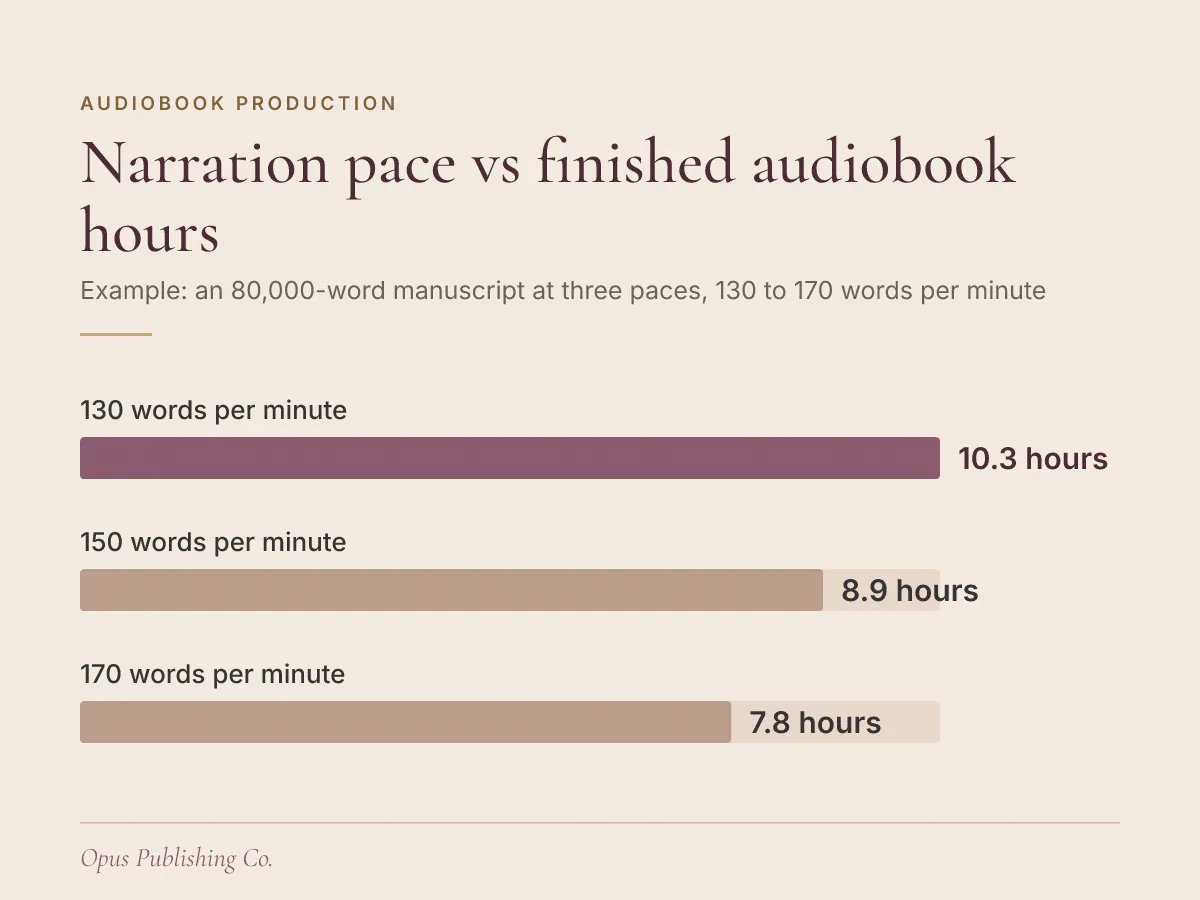
Say you have an 80,000-word novel. The table below runs the same manuscript at three example paces, so you can see what the pace assumption is really doing to your plan.
| Example narration pace | Minutes of finished audio | Finished hours |
|---|---|---|
| 130 words per minute | 80,000 / 130 = 615 | 10.3 hours |
| 150 words per minute | 80,000 / 150 = 533 | 8.9 hours |
| 170 words per minute | 80,000 / 170 = 471 | 7.8 hours |
The spread between the top row and the bottom row is 2.5 hours of finished audio. Narration is usually sold by the finished hour, so that spread is the difference between two budgets, not a rounding error.
Which word count you feed in matters too. Use the final, copy-edited manuscript, and include the words that get read aloud but often sit outside the main text: chapter titles, a dedication if you want it narrated, author's notes, and any appendix you expect in the audio edition. Leave out anything you do not expect in the audio edition, such as an index.
How Do You Measure Your Narrator's Words Per Minute?
Measuring a narrator's pace takes about ten minutes. Ask for a performance-pace recording of a passage from your own book, note the running time to the second, then divide the passage's word count by the minutes recorded.
Run it like this:
- Pick two passages of 1,500 to 2,000 words each, one dialogue-heavy and one descriptive or expository. Pace differs between them, often noticeably.
- Ask for each passage at performance pace, the way the finished book will sound, not a flat read-through.
- Note the exact running time of each file, including the pauses the narrator leaves at scene breaks.
- Divide. For example, 1,800 words that run 11 minutes 30 seconds works out as 1,800 / 11.5 = 157 words per minute.
- Plan with the slower of the two figures, and keep the faster one as your optimistic case.
Most auditions give you this material for free. A narrator auditioning for your book is already recording your prose at performance pace, so the audition file plus a word count is a measurement, not an extra favor to ask.
If you are narrating the book yourself, measure yourself. Do it after the room and the microphone are sorted out, because a cramped read in a bad space is slower than a comfortable one. Narrate Your Own Audiobook: Room, Mic and ACX Specs covers that setup.
Why Does an Audiobook Length Calculator Miss the Real Run Time?
Audiobook length calculators miss because they assume one pace for a whole book and count only the manuscript. Finished audio also carries chapter headers, credits, the pauses a narrator leaves at scene breaks, and room tone at the start and end of every file.
Here is what sits between your word count and the finished run time:
- Prose density. Dialogue with distinct character voices, beats and reaction pauses runs at a different pace from clean expository nonfiction. One pace figure for a whole book is an average, not a measurement.
- Chapter headers. ACX, the Audiobook Creation Exchange, asks for one chapter or section per file, each file including its section header, for example Chapter 1. Those words get narrated in every single file.
- Credits. ACX requires opening credits that state the audiobook's title, author and narrator. Closing credits should indicate the book is finished, and ACX's stated best practice is "You have been listening to..." with the title, author and narrator, followed by "The End".
- Room tone. Room tone is the sound of your silent recording space with nobody speaking. As of November 2026, ACX's audio submission requirements ask for between 1 and 5 seconds of it at the beginning and end of every file, and never more than 5 seconds.
- Retakes. Pickups (the lines re-recorded to replace mistakes) do not change the finished length, but they do change the schedule, which is the number authors usually care about more.
None of that is a reason to skip the estimate. It is a reason to carry a range instead of a single number: a slower figure for the budget and a faster one for the best case.
How Many Files Will Your Audiobook Need for ACX?
ACX wants one file per chapter or section, each including its section header, and each file 120 minutes or shorter. Your chapter list is therefore your file plan, and any section that runs past the file length limit has to be split across more than one file.
Work out whether you are anywhere near that ceiling before recording starts:
- Take your finished-hour estimate and multiply by 60 to get finished minutes.
- Divide by your chapter count for an average chapter length.
- Compare your longest chapter against the 120-minute limit, not the average one.
For example, an 80,000-word novel at 8.9 finished hours across 32 chapters averages 8.9 x 60 / 32 = 17 minutes a chapter, so nothing in it is close to the ceiling. The books that do hit it are the ones recorded as a single continuous piece, long omnibus editions, and nonfiction delivered in a handful of very long parts.
When an audiobook chapter does need a file split, split it at a clean break in the narration rather than mid-scene, keep the section header on the file that carries it, and keep file names to standard US alphanumeric characters. Plan the retail sample at the same time: ACX asks for 5 minutes or less and recommends using the first five minutes of the book, and samples must not contain explicit material.
Two more requirements shape how files get recorded rather than how long they run. Audio has to be all mono or all stereo, consistent throughout. Each file also has to sit between -23dB and -18dB RMS, a measure of average loudness, with peaks under -3dB and a noise floor under -60dB RMS. Encoding is 192 kbps or higher CBR (constant bit rate) MP3 at 44.1kHz. ACX Audio Requirements Explained in Plain English walks through the full specification.
How Long Does It Take To Record an Audiobook?
Recording time always runs longer than the finished length, because narrators stop, correct and re-read, and the audio is then edited, proofed and mastered. Your finished-hour figure is the output of that work, not a measure of the effort, so ask your narrator for a delivery date in weeks.
Per finished hour, usually written PFH, means one hour of edited audio a listener hears, not one hour of the narrator's time. A finished hour audiobook rate is what narrators and studios usually quote against, which is why your estimate is a budget document: multiply the finished hours by the quoted PFH rate and you have the narration line.
Rates move with the narrator's experience, union status, and whether you are paying a flat fee or sharing royalties, so take the figure from the quotes in front of you rather than from a calculator. What you can do is make the quotes comparable. Send every narrator the same word count, the same two sample passages and your slower finished-hour figure, and ask them to quote against that.
Booth time also depends on how clean the manuscript is. A marked-up script with pronunciations, character name spellings and instructions for lists and footnotes saves re-reads. Prepare Your Manuscript for Audiobook Narration covers what to mark up before anyone records.
Can AI Narration Change the Length Math?
ACX requires narration performed by a human and prohibits unauthorized AI or text-to-speech narration, as of November 2026. That makes pace data measured from synthetic voices the wrong input for a title you intend to sell through ACX, however confident a calculator built on that data looks.
Worth knowing while you research: several of the calculators ranking for this search are published by AI narration tools, and the words-per-minute figures they advertise come from synthetic voices reading other people's books. A synthetic voice holds one pace perfectly. A human narrator does not, which is the whole reason a measured range beats a single constant.
If you are considering AI narration for a different platform, treat it as a separate decision with its own distribution rules, and check the terms of each store you plan to sell through before you commission anything.
What To Do This Week
Turn the estimate into something you can send to a narrator.
- Pull a clean word count from the final copy-edited manuscript, including the headings and extras you want narrated.
- Ask your shortlisted narrators for two performance-pace passages, or pull them from auditions you already have.
- Measure both paces, then run the division twice. Write the slower finished-hour figure into the budget and keep the faster one as upside.
- Count your chapters, find the longest one, and check it against the 120-minute file limit so you know now whether anything needs splitting.
- Ask for quotes per finished hour against the slower figure, with a delivery date, and confirm who handles editing, proofing and mastering.
Do the measurement before you commit to a release date. A pace you measured is worth more than any number a calculator hands you, and it costs you one afternoon.