Your manuscript is finished and a narrator is booked. The file you hand over should not be the file you sent your print formatter. To prepare a manuscript for audiobook narration, you build a separate recording script, cut the parts that only work on a page, and attach a pronunciation guide. Do that work before the first session and you pay for one recording instead of two.
How Do You Prepare a Manuscript for Audiobook Narration?
Preparing a manuscript for audiobook narration means producing a second document: the recording script. Copy your final manuscript, delete anything that only makes sense on a page, reword visual references for the ear, mark where the files split, and attach a pronunciation guide.
Work in this order, because each step changes the one after it:
- Save a copy named something like
Title_AudioScript_v1. Never edit your print or ebook master. The two files will drift, and you want the print file untouched for reprints. - Strip the print-only furniture: running heads (the repeated title line at the top of a print page), page numbers, the index, cross-references to page numbers, and ornamental glyphs.
- Reword anything that assumes the reader can see the page.
- Decide, section by section, what gets narrated and what does not, then set your chapter breaks so they match the files your narrator will deliver.
- Build the pronunciation guide last, when the final text is settled, so you are not guiding the narrator through words you later cut.
The script is also where performance notes live. Keep them in square brackets so they read as instructions and never as prose, and tell your narrator in the covering email that bracketed text is not to be read.
What Should You Remove From the Print Manuscript?
Remove every element that exists to help an eye move around a page. Running heads, page numbers, the index, decorative scene-break glyphs, figure and table captions, and footnote markers all read as noise or dead air in an audiobook.
- Page-number cross-references. "See the table on page 112" has no meaning in audio. Replace it with a verbal pointer such as "in the chapter on dialogue tags".
- Footnotes and endnotes. Fold anything essential into the sentence that needed it, and cut the rest. A narrator reading a citation mid-paragraph breaks the listener's attention and earns nothing.
- The index and the table of contents. Both are page-finding tools. Nobody listens to an alphabetical list of page numbers.
- Figures, tables and charts. Either write a sentence that carries the same point in prose, or mark the block to skip. Leaving a caption in place without its image is the worst of the three options.
- Ornamental scene breaks. Asterisks and other ornamental dividers are invisible to the ear. Replace each one with a bracketed cue your narrator will recognize, used identically every time.
- Visual phrasing. "As you can see below", "the diagram above" and "on the left" all need rewriting. Most of them become "as you have heard" or a plain restatement.
Front matter, meaning everything printed ahead of chapter one, needs a decision rather than a rule. A dedication is usually worth hearing, and a copyright page usually is not, but make the call explicitly and write [SKIP] or [READ] next to each block so your narrator is not guessing at the start of session one.
If a chapter turns out to need real sentence work rather than deletions, that is a line editing job and not a prep job. Our guide to developmental, line and copy editing explains which pass addresses what, and line editing is the pass that handles rhythm and sentence flow.
How Do You Write an Audiobook Pronunciation Guide?
An audiobook pronunciation guide is a list of every word a narrator could plausibly get wrong, with your preferred pronunciation spelled out phonetically. Build it from character names, invented terms, place names, foreign words, acronyms and numerals, then send it with the script.
Four columns are enough, and the third one does the real work. Spell the pronunciation out in syllables a non-linguist can read, with the stressed syllable capitalized. Do not use the International Phonetic Alphabet unless your narrator asks for it. Here is the layout, with example entries:
| Word | First appears | Say it as | Note |
|---|---|---|---|
| Saoirse | Chapter 1 | SEER-sha | Lead character, in nearly every chapter |
| Beauchamp | Chapter 4 | BEECH-um | English family name, not the French pronunciation |
| NDIS | Chapter 9 | letter by letter | Never read as a word |
| 1984 | Chapter 2 | nineteen eighty-four | The year, not one thousand nine hundred |
Two categories trip authors up. Acronyms need an explicit instruction, because a narrator cannot tell from the page whether NASA is a word and NDIS is four letters. Numerals need the same: write out how you want years, decimals, measurements and phone numbers spoken, since "1,500" can be read as fifteen hundred or as one thousand five hundred.
Invented words are your call. Fantasy and science fiction authors sometimes prefer to let an experienced narrator choose, which is a legitimate decision, but make it a decision. Silence on the page means the narrator guesses, and a guess that lands in chapter one lands in every chapter after it.
How Should You Split the Script Into Audiobook Chapter Files?
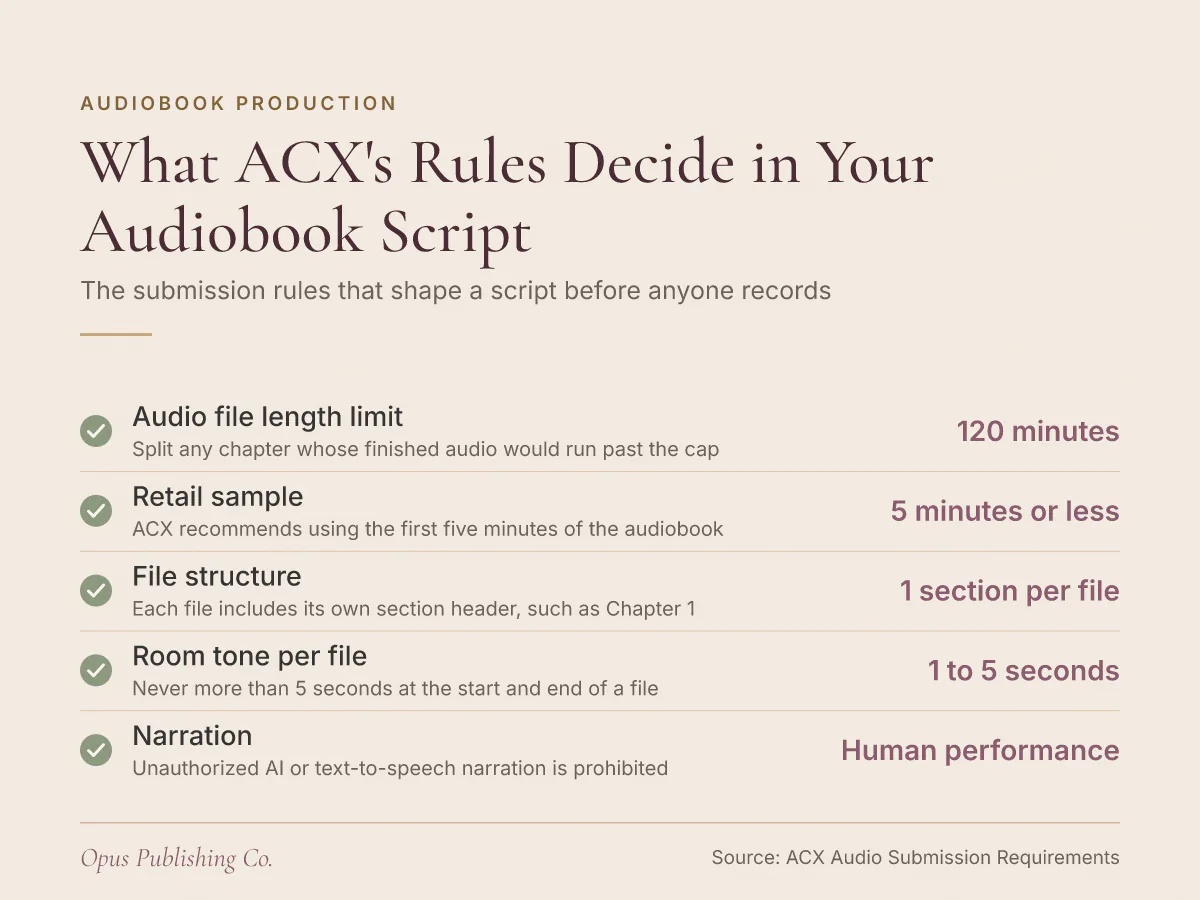
ACX's audio submission requirements call for one chapter or section per file, each file including its own section header, so your script's chapter breaks become your file list. As of October 2026, each file must be 120 minutes or shorter.
ACX is the audiobook production platform whose submission requirements your finished files have to pass. The table below maps the rules that shape a script to the decisions they force on you.
| ACX submission rule | What the requirement says | What it decides in your script |
|---|---|---|
| File structure | One chapter or section per file, each including its section header such as Chapter 1 | Your chapter list is your file list, and every file opens by naming its section |
| File length | Each file must be 120 minutes or shorter | A long chapter needs a split point you choose in advance |
| File names | Standard US alphanumeric characters only | Rename sections containing accents or symbols before delivery |
| Retail sample | 5 minutes or less, and ACX recommends using the first five minutes | Your opening pages are the sample, so nothing dull can sit in front of them |
| Narration | Performed by a human; unauthorized AI or text-to-speech narration is prohibited | Budget for a human performance, or narrate the book yourself |
Most chapters never approach the length cap, so the cap only matters for the outliers: a novella-length part in an omnibus, a long transcript, a single unbroken essay. Pick the split point yourself at a scene break, name the two sections in your script, and the narrator records them as two files.
ACX's requirements also ask for between 1 and 5 seconds of room tone at the start and end of each file, and never more than 5 seconds. Room tone is the sound of the recording space with nobody speaking. Delivering it is your narrator's job, not yours, but it is a reason to mark chapter boundaries cleanly rather than leaving a narrator to decide where one section ends. For the rest of the technical specs, including levels and encoding, see our plain-English walkthrough of ACX's audio requirements.
What Goes in the Audiobook Opening and Closing Credits?
Opening credits must state the audiobook's title, author or authors, and narrator or narrators, according to ACX's submission requirements. Closing credits should indicate that the book is finished. Write both as script lines in your document so nobody improvises them in the booth.
ACX gives its best-practice wording for the close: "You have been listening to..." with the title, author and narrator, followed by "The End". A workable pair of script blocks looks like this:
- Opening file: the title, then "written by" and your name, then "narrated by" and the narrator's name. One line each, read plainly.
- Closing file: "You have been listening to", then the title, author and narrator again, then "The End".
Write the narrator's name exactly as they want it credited, and ask them for the spelling rather than copying it from an invoice. If your book has two authors or a translator, decide the order and the wording now. Credits are the one part of the script that nobody edits later, because by the time anyone notices, the files are finished.
Does Your Opening Chapter Work as an Audiobook Retail Sample?
Your opening chapter is probably your retail sample. ACX's requirements cap the sample at 5 minutes or less, recommend using the first five minutes of the audiobook, and state that samples must not contain explicit material. Read your first pages aloud and time them before you lock the script order.
A retail sample is the short clip a listener hears before deciding to buy, and two things in your script can ruin it. The first is front matter: if a content note, an epigraph and a dedication all sit ahead of chapter one, a listener's five-minute audition is mostly housekeeping. The second is explicit content in the opening scene, which rules out the default sample entirely and means you choose a different passage.
Say you have a 70,000-word literary debut that opens with two pages of epigraph before the first line of prose. Marking the epigraph to be read after the opening credits, or moving it behind chapter one in the audio edition, buys back most of the sample. Nothing in the print book has to change.
Can You Use AI Narration Instead of a Human Narrator?
ACX's audio submission requirements state that narration must be performed by a human, and that unauthorized AI or text-to-speech narration is prohibited. If ACX is in your distribution plan, budget for a human performance or narrate the book yourself.
The rules differ by platform, so check the rules of every audiobook platform you intend to sell through. The word "unauthorized" is doing real work in that rule, and the requirements page does not define which uses count as authorized. Ask the platform directly rather than inferring an answer from a vendor's marketing page, and get it in writing before you pay for a synthetic voice.
Prep differs for the two routes, which is why the decision comes before the script work. A human narrator needs your pronunciation guide, your bracketed performance cues and your character notes. A synthetic voice needs the text itself to be unambiguous, because it will not ask you what a word means.
What to Do This Week
Set aside two sittings. In the first, make the script copy and strip the print-only elements. In the second, build the pronunciation guide and mark your file splits. Both cost less than re-recording a chapter a narrator has already performed.
- Duplicate the manuscript, rename it as an audio script, and put the print master somewhere you will not open by accident.
- Search the file for "page", "above", "below", "see figure" and "chapter one" to catch every visual reference in one pass.
- Mark every front matter and back matter block
[READ]or[SKIP], including the dedication, epigraph, acknowledgements and author bio. - Build the four-column pronunciation table, starting with your character list and every proper noun your spellchecker flags.
- Check your chapter list against the file rules: one section per file, nothing over 120 minutes, and file names in plain alphanumeric characters.
- Read your first five minutes aloud, timed, and confirm it is the passage you want a buyer to hear.