You finished the draft, and now you are about to pay someone to read it. A self-editing checklist decides how much of that money buys real editorial thinking instead of cleanup you could have done yourself. Run your passes from the largest problem to the smallest, one job per pass, and stop when a full pass turns up nothing but matters of taste.
What Should a Self-Editing Checklist Cover, and in What Order?
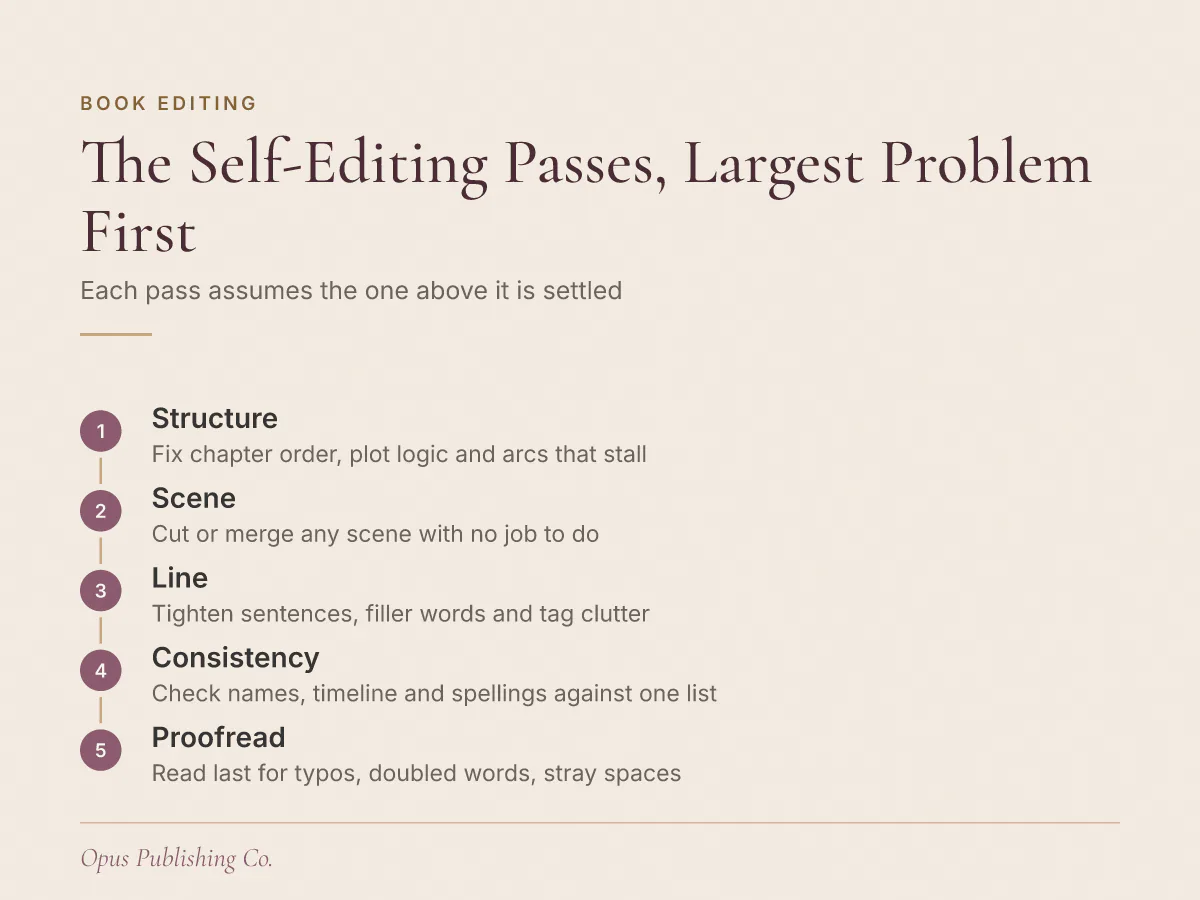
A self-editing checklist for a novel covers five passes in descending order of size: structure, scene, line, consistency, then proofread. Each pass assumes the one above it is settled, because a large revision destroys small fixes and never the other way around.
- Structure. Chapter order, plot logic, arcs that start and go nowhere, the ending the book actually earns.
- Scene. Whether each scene has a job. If you cannot say what changes in it, the scene is a candidate for cutting or merging.
- Line. Sentence by sentence: filler words, hedges, dialogue tags, three paragraphs in a row with the same shape.
- Consistency. Names, ages, timeline, geography, invented spellings, which of your characters has the scar.
- Proofread. Typos, doubled words, stray spaces, broken quotation marks. Last, always, because every revision adds fresh errors.
The passes are separate on purpose. Reading for structure while fixing commas means you do both badly, and a page you have just rewritten is the page you read least carefully.
Which Self-Editing Passes Save the Most Editing Time?
The structure pass saves the most, because its problems get more expensive the longer they survive. A plot hole you catch yourself costs one rewrite. The same hole found by a developmental editor, after you polished every sentence around it, costs the polish too.
Developmental editing is the pass that looks at story, structure and character rather than wording. Line editing works on prose at sentence level. Copy editing fixes grammar, usage and consistency against a style guide. Proofreading is the final surface check on the laid-out text.
| Your pass | What you fix | What it takes off the paid edit | Skip it and |
|---|---|---|---|
| Structure | Chapter order, plot logic, arcs that stall | A developmental editor naming problems you could name yourself | You buy a diagnosis instead of a solution |
| Scene | Scenes with no job, repeated beats, slow openings | Notes telling you a scene is redundant | Your editor queries scenes you already doubted |
| Line | Filler words, hedges, tag clutter, repeated rhythms | Mechanical tightening that eats into a line edit | A line editor spends the budget on your worst habits |
| Consistency | Names, timeline, geography, invented spellings | Queries about which detail is correct | The copy editor guesses, or asks you a long list of questions |
| Proofread | Typos, doubled words, stray spaces | Noise that hides real errors | Small mistakes distract from the work you paid for |
Order matters more than thoroughness here. An author who does a rough structural pass and a rough line pass, in that order, hands over a better manuscript than one who does an immaculate line pass on a draft that still needs restructuring.
What Self-Editing Should You Skip Because Your Editor Will Redo It?
Four kinds of self-editing waste your time: polishing prose before the structure is settled, laying out pages before the text is final, settling house style yourself, and smoothing your own voice flat. Each one is work that a later stage of production undoes.
- Line polish on unsettled structure. Cut a chapter and every sentence you perfected inside it leaves with it. Polish after the structure holds.
- Page layout and typesetting. Typesetting is the stage where edited text is laid out into final pages. Formatting happens after editing, because editing changes line and page breaks. Setting fonts, indents and page breaks by hand in your draft only has to be undone.
- House style decisions. Serial commas, hyphenation, how you render numbers and dates: a copy editor sets these on a style sheet, which is the document that records every style choice made for your book. Be consistent, then let your copy editor decide.
- Accepting every grammar software suggestion. Grammar tools flag patterns, not meaning. They will neutralize a deliberate fragment, a dialect spelling or a voice you chose on purpose.
The last one is the real risk. Authors arrive with manuscripts that have been smoothed until nothing in them is wrong and nothing in them is theirs. Keep a copy of the draft before any tool touches it, and when a suggestion and your ear disagree, trust your ear and flag the line for your editor.
How Do You Know When to Stop Self-Editing and Hire an Editor?
Stop when a full pass produces only changes another writer would argue about with you. Problems you can still name are yours to fix. Problems you cannot see, or cannot agree with yourself about, are exactly what you are hiring an editor for.
Three signals that your own passes are done:
- The notes repeat. You keep rewriting the same paragraph in both directions, which means you are choosing, not fixing.
- The problems you find are tiny. A pass that turns up commas and a dropped quotation mark is a pass that found nothing structural, so there is nothing structural left that you can see.
- You are protecting something. If you can feel yourself steering away from a chapter, that chapter is the reason to hire someone whose income does not depend on liking your book.
There is no useful number of drafts, and no rest period that works for everybody. A better test than a calendar: can you read a page without predicting the next sentence? If you are reading your memory of the book rather than the words on the page, the draft needs more distance, not another pass.
How Do You Prepare a Manuscript for an Editor?
Send one file, in one state, with the decisions already made. Most of the friction in a first edit comes from file housekeeping, not from the writing, and a clean handoff means the first thing your editor does is read rather than reconstruct.
Run this checklist on the file before it leaves your desk:
- One document, one version. Combine chapter files into a single manuscript and delete the old versions from the folder you send.
- Resolve tracked changes. Tracked changes are Word's record of every edit, shown as markup. Accept or reject your own before sending, so your editor's markup is the only markup.
- Delete your working comments. Notes to yourself read as instructions to the editor.
- Use real heading styles. Mark chapter openings with a heading style instead of a bigger bold font, so structure survives into formatting.
- Strip the layout. Plain body text, standard spacing, no manual page breaks mid-chapter, no decorative fonts.
- Name the file properly. Title, author, date, and a version marker you will still recognize later.
- Write a short brief. Your genre and audience, what you know is weak, what is deliberate (the present tense, the unreliable narrator, the regional spelling), and what you want from the edit.
That last item is the one authors skip, and it changes the edit most. An editor who knows your dialect spellings are intentional spends the pass on your story instead of querying your choices. The same clean, well-structured file is what prepares a manuscript for audiobook narration later, so the work is not single use.
Which Edit Do You Buy After Self-Editing, Developmental or Copy?
Buy a developmental edit when your doubts are about the book, and a copy edit when your doubts are about the sentences. A thorough self-edit does not change which one you need. It changes how much of it goes on problems you already knew about.
- Structure still bothers you. The ending lands flat, a subplot dies, the middle sags. That is developmental editing, and no amount of line work will substitute for it.
- The story works, the prose is uneven. Scenes do their job but the writing is baggy. That is a line edit.
- Story and prose are settled. You want correctness and consistency. That is a copy edit, followed by a proofread after formatting.
Beta readers belong before you buy any of it. Beta readers are ordinary readers from your audience who tell you where they got bored or confused, which is cheap information about the structural pass you just ran. Their confusion is data; their proposed fixes usually are not.
If you are weighing the levels against each other, developmental, line and copy editing compared walks through what each one touches and what it leaves alone.
Your Next Steps This Week
Pick the pass you can finish, not the one that sounds most thorough. A structural read of the full manuscript is the pass that pays for itself, and the one most authors talk themselves out of.
- Read the whole draft in as few sittings as you can, taking notes and fixing nothing.
- Turn those notes into a list of structural changes, then make them before you touch a sentence.
- Run the consistency pass with a single list of names, places and spellings open beside you.
- Write the short brief for your editor while the draft is fresh in your mind.
- Ask any editor you are considering what state they want the file in, and what they do not want you to fix first.