You are ready to hire an editor, and the price page lists three services you cannot tell apart. Developmental editing, line editing and copy editing are three different jobs that happen in a fixed order: developmental editing fixes what the book is, line editing fixes how the sentences read, and copy editing fixes what is correct and consistent. Buy the later passes only once the earlier work is finished.
What Is the Difference Between Developmental, Line and Copy Editing?
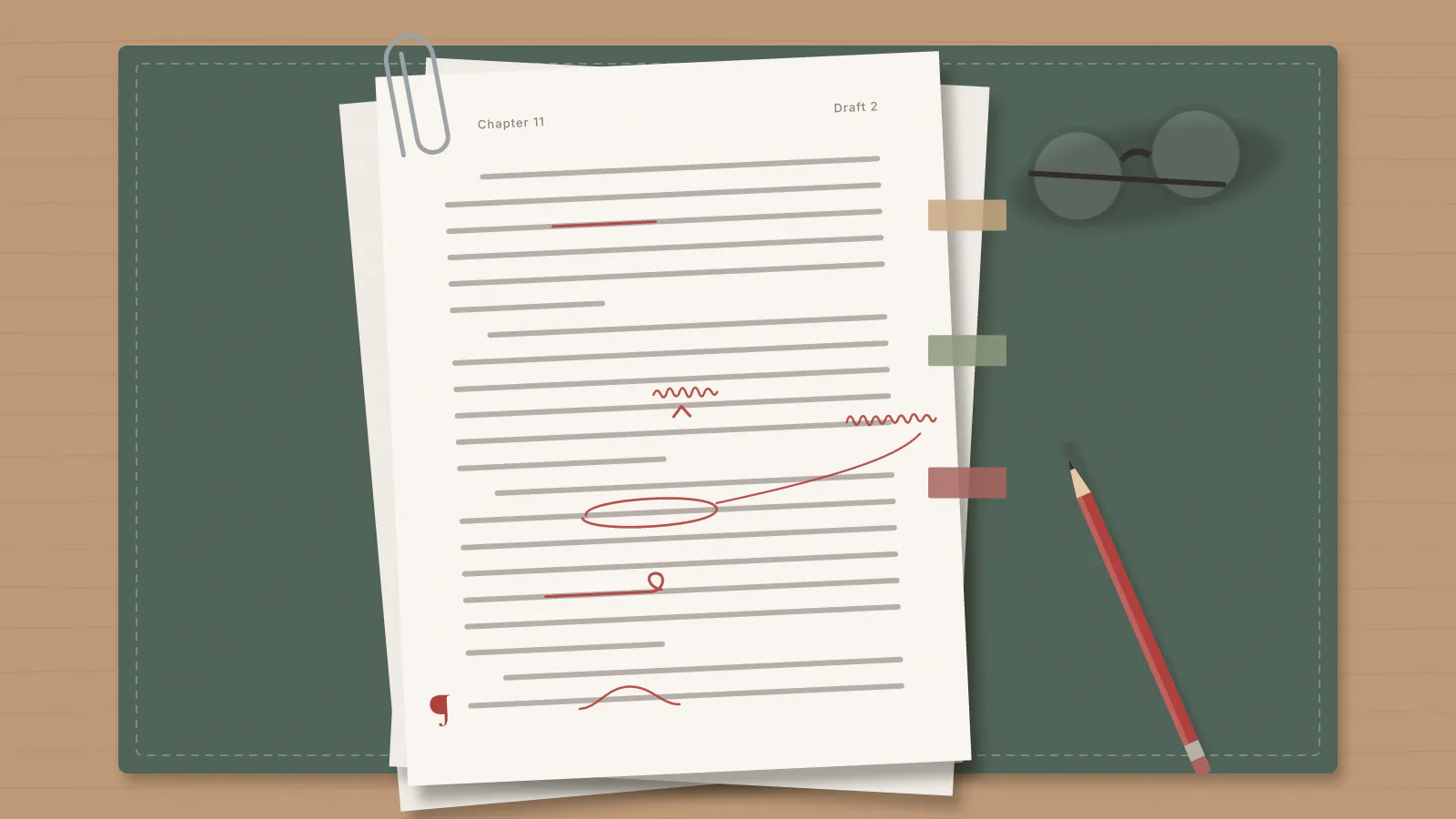
Developmental editing works on the whole book: structure, pacing, what is missing and what sits in the wrong chapter. Line editing works at the level of the sentence and the paragraph: rhythm, clarity, repetition, word choice. Copy editing works on correctness and consistency: grammar, spelling, punctuation, usage, continuity.
The three names describe three different depths of change, and the deeper the pass, the earlier it belongs. A developmental editor can tell you to delete a subplot. A line editor assumes the subplot stays and makes its sentences land. A copy editor assumes the sentences are final and makes them correct.
Proofreading is a fourth job, not a cheaper version of copy editing, and it happens after your book is formatted. Those four passes are the types of book editing an independent author actually buys.
| Edit | What it works on | What it fixes | What to ask for in writing |
|---|---|---|---|
| Developmental editing | The whole manuscript | Structure, pacing, plot holes, thin motivation, unclear purpose or audience | An editorial letter: a written assessment of the whole book, plus notes in the manuscript |
| Line editing | Sentences and paragraphs | Flat prose, repetition, clumsy rhythm, wordiness, tone that drifts | Tracked changes in your file, meaning edits you can accept or reject one by one |
| Copy editing | Words and mechanics | Grammar, spelling, punctuation, usage, continuity slips, inconsistent style | Tracked changes, author queries and a style sheet of every style decision |
| Proofreading | The formatted pages | Typos, bad breaks, stray spacing, wrong running heads, missed corrections | A marked proof or a list of corrections to apply |
Which Edit Does Your Book Need First?
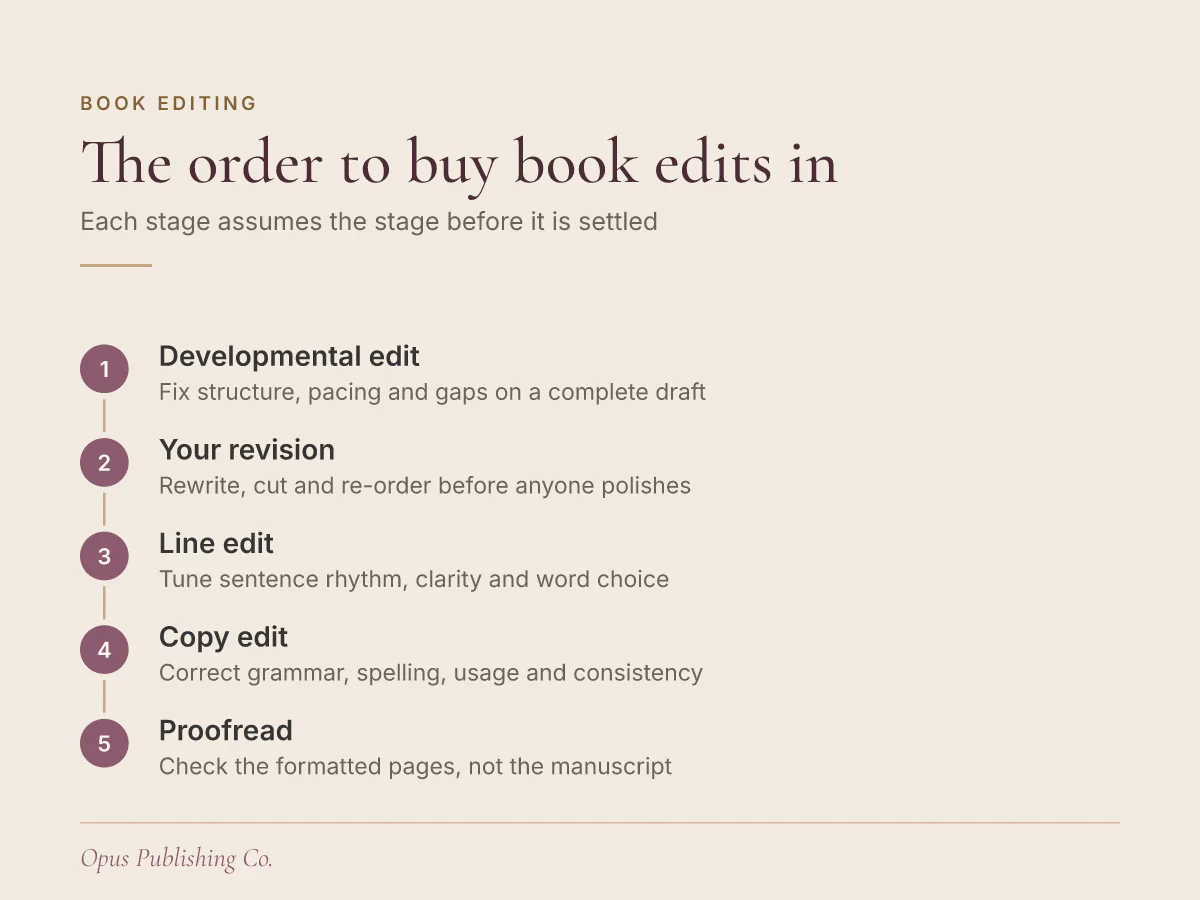
Developmental editing comes first, before any sentence-level work. The order follows the size of the change: structure, then prose, then correctness, then a final check on formatted pages. Each stage assumes the stage before it is settled.
The stages of book editing, in order:
- Developmental edit. An editor reads the complete draft and reports on what the book is doing and where it fails to do it. No line-level polishing.
- Your revision. You rewrite, cut and re-order based on that report. This is the longest stage, and it is yours alone.
- Line edit. An editor works through the revised prose sentence by sentence for clarity, rhythm and voice.
- Copy edit. An editor corrects grammar, spelling, punctuation and usage, and records every style decision.
- Proofread. A fresh reader checks the formatted pages, not the manuscript file.
Stage two is the one most authors forget to plan for, and it is the reason the order matters to your budget. Say you pay for a line edit on a 70,000-word draft, then a developmental read tells you the first three chapters are backstory. You cut them, and you have paid to polish prose that no longer exists in the book.
Doing the passes out of order also wastes the editor's attention. A copy editor reading an unsettled draft spends their hours on sentences you are about to rewrite, and the typos they catch arrive in text that will not survive.
How Do You Know Which Edit Your Draft Needs?
Read the symptoms in your draft, not your word count. Readers confused about what happened or who the book is for point to a developmental edit. Prose that is correct but dull points to a line edit. A settled draft with typos points to a copyedit.
Signs you need a developmental editor
- Beta readers, the volunteer readers who read a draft and respond as readers rather than editors, lost interest at the same point, or several asked the same question about a character's motive.
- You cannot say in one sentence what your book is about or who it is for.
- You are still moving chapters around, or you have two versions of the same scene in the file.
- The middle feels slow to you, and you have no idea which parts to cut.
- Your nonfiction chapters each make sense, but the argument does not build from one to the next.
Signs you need a line edit
- Every sentence is grammatically fine, and the pages still feel flat.
- You repeat favorite constructions, and you notice it only when you read aloud.
- Dialogue sounds like one person talking in different hats.
- Your paragraphs run long, and you cannot tell which clauses are doing the work.
- The story and the structure are settled, so nothing you change now will be deleted later.
Signs your manuscript is ready for copyediting
- The structure is locked. No chapter is moving, and no scene is being rewritten.
- You have stopped rewriting the same paragraph every time you open the file.
- You are catching typos, inconsistent spellings and a character whose eye color changed in chapter nine.
- You want the book correct and consistent, not different.
Two symptoms often appear at once, and the earlier pass still wins. If you need both structure and sentence work, book the structural pass, revise, then decide what the prose needs.
What Is the Difference Between Line Editing and Copy Editing?
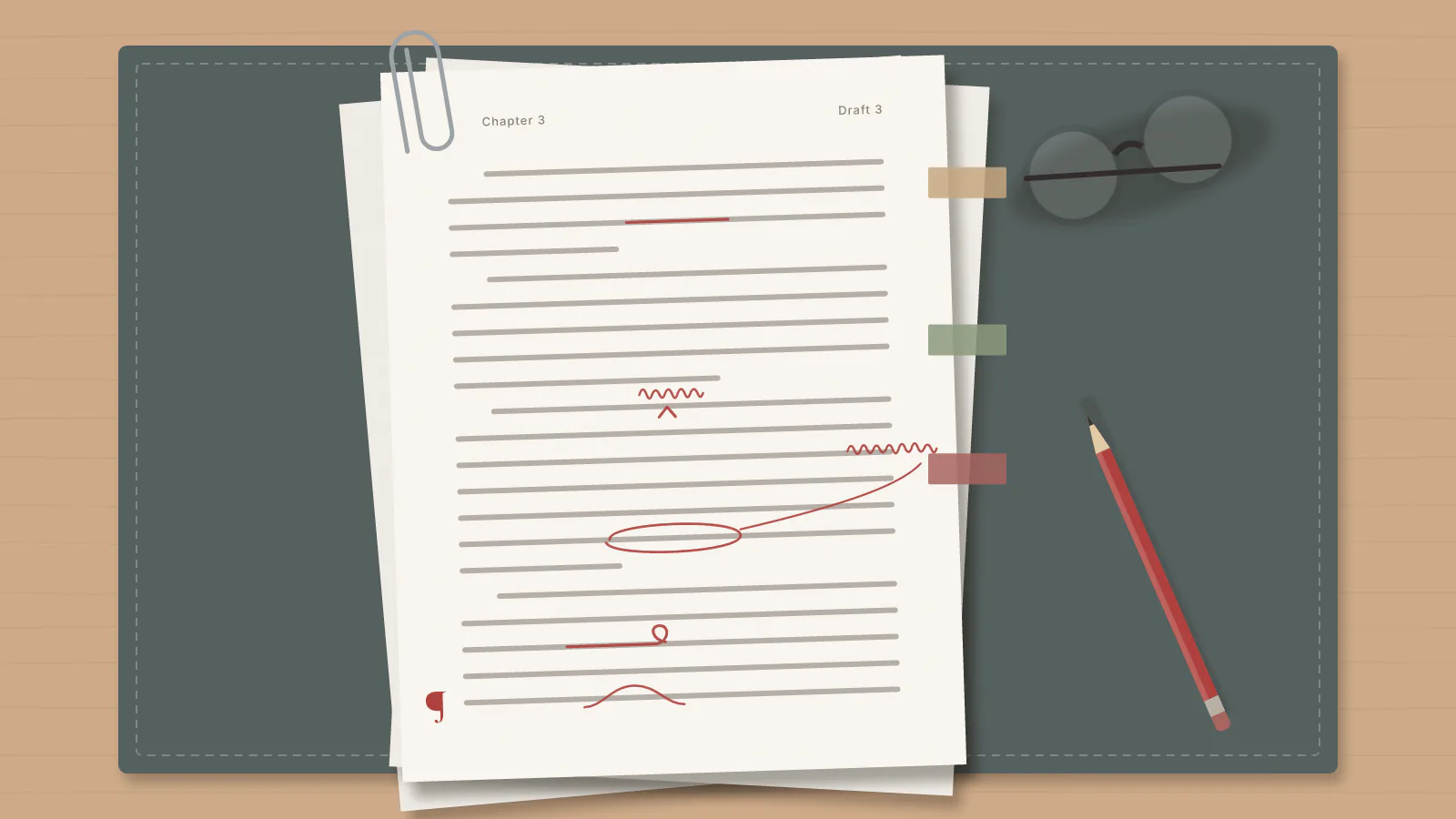
Line editing asks whether a sentence works. Copy editing asks whether a sentence is correct. A line editor may rewrite a clumsy paragraph for rhythm or cut a repeated image. A copy editor leaves your voice alone and makes the text accurate and consistent.
The two passes overlap at the edges, which is why the labels confuse people. A copy editor who spots a genuinely confusing sentence will usually query it, and a line editor who sees a misused word will fix it. The difference is what each one is being paid to look for.
Copy editing is also the pass that produces a record. A copy editor works to a style guide, often the Chicago Manual of Style for American trade books, and keeps a style sheet: the running list of spellings, hyphenations, capitalizations, character names, places and timeline details chosen for your book. That sheet is what keeps your proofreader from "correcting" a deliberate choice later.
The labels themselves are not standardized across the industry. One editor's line edit is another's copyedit, and a package sold as a "full edit" could be either. Compare what you will receive, not the label. Opus's copy editing page lists what that pass includes, and any editor you approach should be able to do the same in a sentence or two.
Do You Need All Three Edits?
No. Not every book needs all three passes. A draft that has already survived hard structural revision, with beta readers who followed it, may need only a copyedit. A first novel drafted straight through usually needs the structural pass more than the polish.
If you can pay for one pass, pay for the one that matches your draft's biggest problem rather than the cheapest one on the list. A copyedit on a broken structure produces a clean book that still loses readers in chapter four. A developmental editing pass on a draft whose structure is already sound tells you things you knew.
The one thing you cannot do is grade your own sentences. You have read them so many times that your eye supplies what the page does not say, which is why authors who edit their own work catch the errors they were already looking for and miss the rest.
What Should You Get Back From Each Edit?
Ask for the deliverables by name before you pay. A developmental edit should return an editorial letter naming the structural problems and what to do about each one. A line edit and a copyedit should return your file with tracked changes and comments.
Three terms are worth knowing before you read a quote:
- Tracked changes. Edits recorded in the file, usually in Microsoft Word, so you can accept or reject each one. You stay in control of every change.
- Author queries. Comments addressed to you rather than corrections, asking you to confirm a fact, a name or an intended meaning. Answering them is part of your job.
- Style sheet. The record of every style and continuity decision made in your book, handed back with the copyedit so later passes stay consistent.
Ask for a sample edit as well: a short, often paid pass on a few pages of your own manuscript, so you can see the depth of the work before you commit to the full book. A sample on your own pages tells you more than any service description can.
Where Does Proofreading Fit After Your Book Is Formatted?
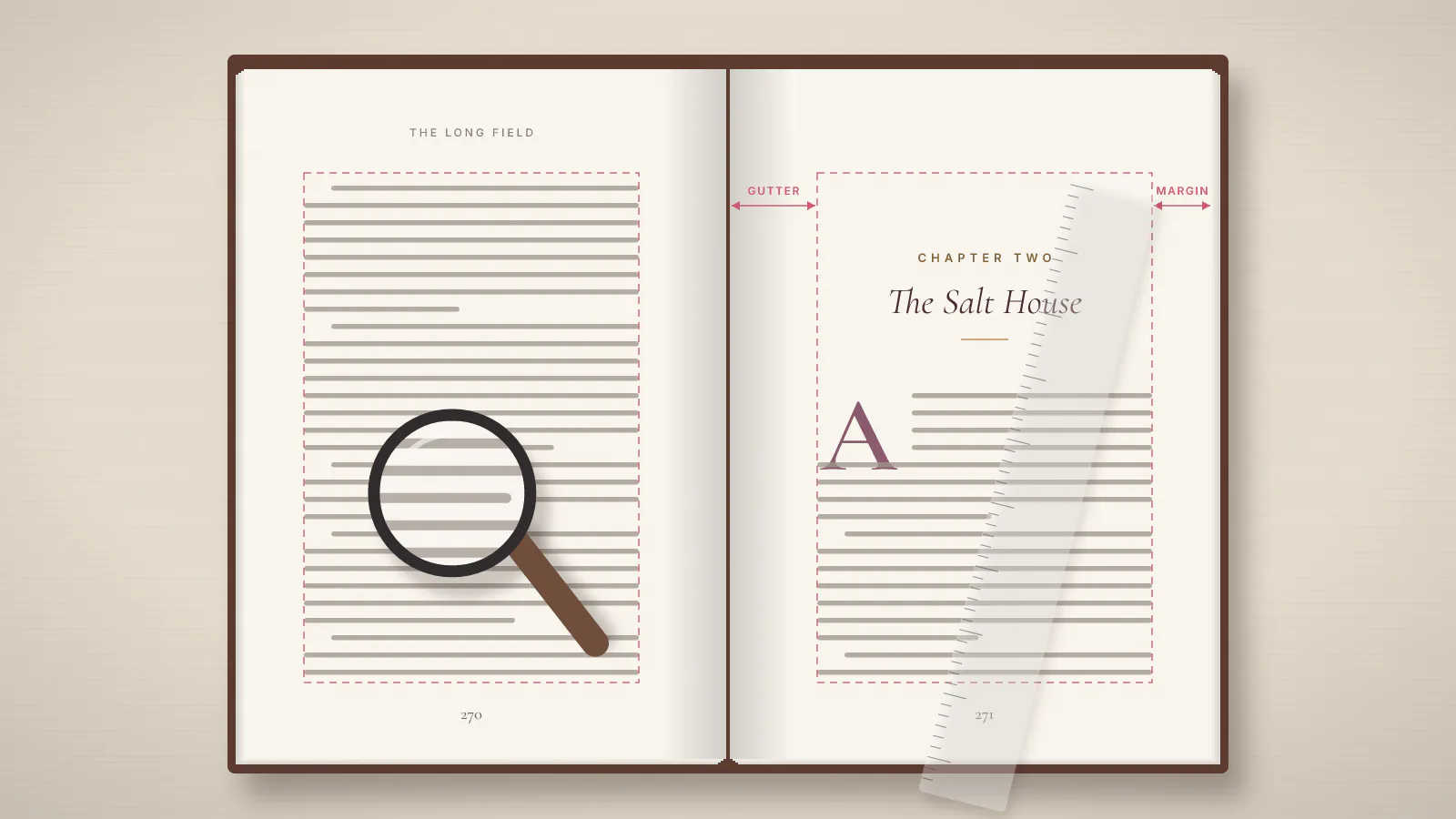
Proofreading comes last, after your interior is formatted, because layout creates errors that never existed in the manuscript file. A proofreader reads the pages as a reader will see them.
Layout brings its own mistakes: bad page breaks, awkward hyphenation, a chapter opening on the left-hand page, a paragraph with a single word stranded on its own line. Watch the running heads too: the small lines of text repeated at the top of each page.
Proofreading and copyediting also differ in how much they are allowed to change. A copyedit changes text. A proofread compares the formatted pages against the corrected text and fixes what slipped, without reopening settled questions of style.
Both the print pages and the ebook deserve a look. An ebook uploaded to Amazon KDP, Apple Books or Kobo reflows to fit the reader's device, so chapter openings, images and tables can behave differently from the print file. If you are still deciding on page size, read our guide to choosing a book trim size before anyone formats the interior, since changing it afterwards means a new proofread.
How to Book the Right Edit This Week
Work from your draft's symptoms, in this order:
- Read your own last two chapters out loud, and write down which of the three symptom lists above they match.
- Reread the feedback you already have from beta readers or a writing group, and sort it into structure, prose and correctness.
- If structure problems dominate, book a developmental edit and nothing else. Schedule your revision time immediately after it.
- If the structure is settled, ask two or three editors for a sample edit on the same pages so you can compare depth, not labels.
- Ask each editor, in writing, what comes back, whether a style sheet is included and when they can take the book.
- Book the proofread only once your interior formatting is final.
Whatever you do first, do not buy a pass whose name you cannot define. An editor who cannot tell you in two sentences what their edit includes is telling you something useful.