Traffic without orders usually points at the product page, not the book. An Amazon book description sells when its first block gives a shopper one specific reason to read the second block, and the rest of it answers the one question that brought them there. Fixing a flat description is more a structure problem than a writing problem, which is why most authors can do it in a sitting or two.
Why Is Your Book Getting Views but No Sales?
Page views count the shoppers who reached your listing, not the shoppers who were ever going to buy. Check the cover, the title and the categories before you rewrite anything, because a browser who never scrolled to the description cannot have been lost by it.
Run this in order, because each step rules out a different suspect. Kindle Direct Publishing, Amazon's self-publishing platform, is shortened to KDP below.
- Open your listing at thumbnail size and see whether the cover still reads. The book cover thumbnail test is quicker than guessing.
- Read your title and subtitle out loud. A shopper should be able to say what kind of book it is from those two lines alone.
- Check that your categories are ones readers actually browse rather than ones that were easy to rank in. Choosing KDP categories that readers browse changes who arrives in the first place.
- Open Amazon's Look Inside preview, the sample shoppers can read from the product page, and read it as a stranger would. A weak opening page loses sales that the description already won.
If the cover reads, the title is clear, the categories are right and the sample holds, the description is the remaining suspect. It is also the cheapest of the four to change, since you edit it from your KDP Bookshelf long after the book goes live.
What Should the First Line of Your Book Description Do?
The first line has one job: make the shopper want the second line. Amazon shows only the opening of a description before a Read more link, so that block is the only part a browser is guaranteed to see. Write it as a predicament or a promise.
A hook is the opening line whose only purpose is to buy you the next line. Three shapes work, and they map onto what the book is.
- A predicament. Put a person in trouble the reader wants resolved. Best for novels and memoir.
- A promise. Name the reader's problem and what changes by the last page. Best for nonfiction and how-to.
- A line of dialogue or a single fact. One sentence the reader cannot leave alone. Works in thrillers, and in children's books where the voice matters more than the plot.
Four openings waste that line, and almost every failing description uses one of them:
- The author's name and credentials, before the reader knows what the book is.
- A genre self-label, such as "this gripping literary thriller".
- An award or a review quote stacked at the top.
- The phrase "this book is about".
None of those answers the only question a shopper has in that moment, which is why they should care.
Open your own listing on a phone, not a laptop. How much shows before the Read more link varies by device and by where the shopper came from, so the only reliable version is the one on your own screen. It is usually shorter than authors expect.
What Structure Should an Amazon Book Description Follow?
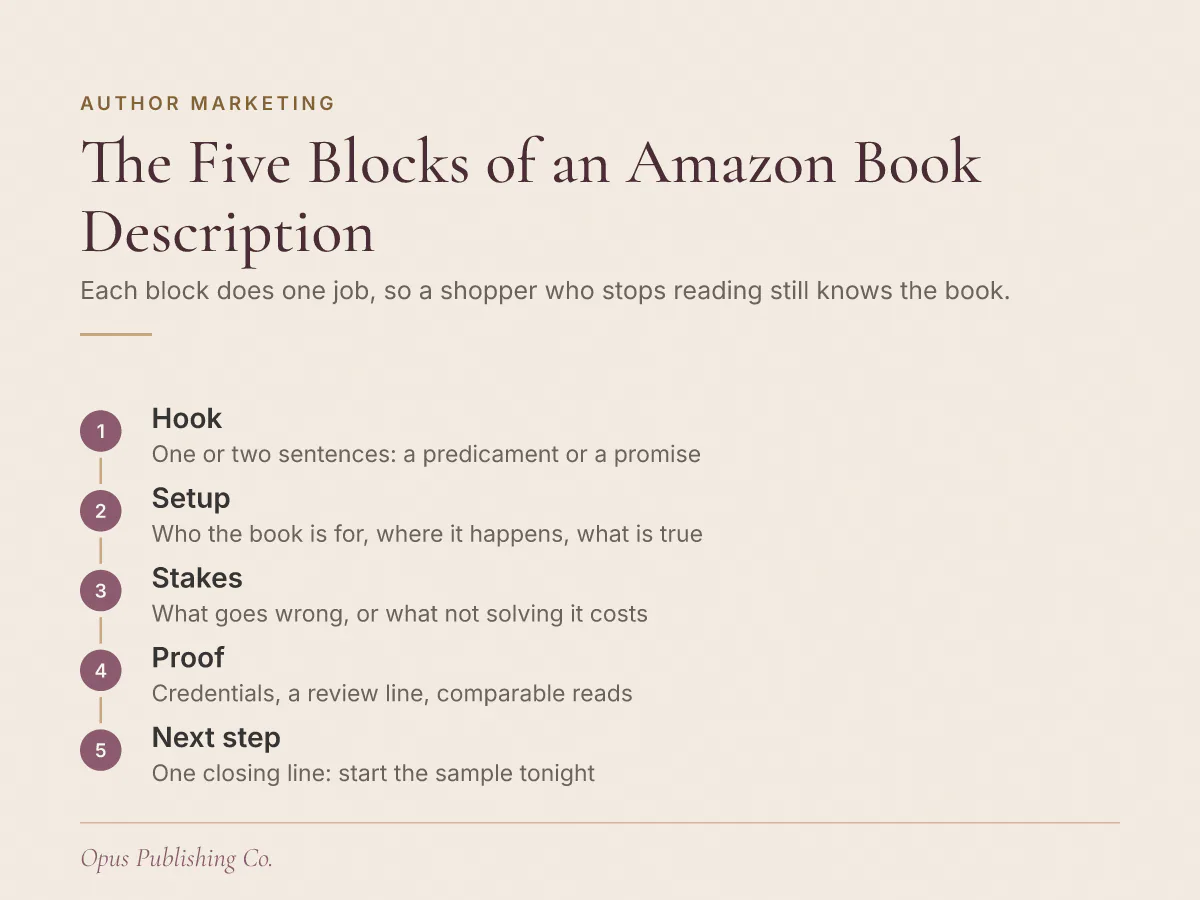
An Amazon book description works in five blocks: hook, setup, stakes, proof, next step. Each block has one job, and a shopper who stops after any block still knows what the book is and who it is for.
- Hook. One or two sentences, in the shapes above.
- Setup. Who the book is about or who it is for, where it happens, and what is already true when the story or the argument starts.
- Stakes. What goes wrong, what the reader risks by not solving the problem, or what the choice costs. Fiction and nonfiction both need this block; nonfiction authors are the ones who usually skip it.
- Proof. The reason to believe you: relevant credentials for nonfiction, a review line or an award for fiction, comparable reading experiences stated as a reader would state them.
- Next step. A short closing line that tells the shopper what to do, such as starting the sample or beginning the first chapter tonight.
Write for the shopper in the description and put your search terms where KDP asks for them. The seven keyword fields are a separate job, covered in what to put in all seven KDP keyword boxes, and stuffing search phrases into the description costs you the sale you were trying to win.
How Long Should an Amazon Book Description Be?
Shorter than you think, and the published limit is not the goal. KDP gives the character limit for the description on its help pages, and most descriptions that fail on Amazon are too long rather than too short. Length is the wrong lever.
The shopper decides in the first block whether to keep reading, so filling the field buys you nothing. Here is the cutting rule, and it is the part most advice leaves out. Delete any sentence that could appear, unchanged, under a hundred other books in your category.
That rule removes more than you would expect:
- Plot recap past the inciting event. The description is not a synopsis.
- Backstory about how or why you wrote the book.
- Your bio, unless your background is the reason to trust the book.
- Genre adjectives applied to your own work: gripping, sweeping, unputdownable, heartwarming.
- Comparisons to famous authors. A shopper reads them as a claim, not as a signpost.
- Theme lists ("a story about grief, family and belonging"). Themes describe what a book was about once you have read it, which is no use to someone deciding whether to start.
What stays is anything only your book could say: a name, a place, a specific thing that goes wrong, a specific thing the reader will be able to do.
How Do Fiction and Nonfiction Book Descriptions Differ?
Fiction descriptions sell a predicament, and nonfiction descriptions sell an outcome. A novel's opening block puts a character in trouble the reader wants resolved. A nonfiction opening block names the problem the reader already has and says what is different once the book is finished.
The blocks stay the same across categories. What changes is what goes in the first one and what counts as proof.
| Book type | What the first block does | What proof looks like |
|---|---|---|
| Literary and genre fiction | Puts a named character in a specific predicament | Review lines, awards, comparable reading experiences |
| Nonfiction and how-to | Names the reader's problem and the outcome | Relevant experience, what the method is built from |
| Children's picture books | Speaks to the adult buying it while promising the child a story | Read-aloud fit, illustration style, series or classroom use |
| Faith-based nonfiction | Names the question or season of life the reader is in | Tradition and sources the book works from, who it is written for |
Children's titles are the ones most often written to the wrong reader. The buyer is a parent, grandparent, teacher or librarian, so the description has to satisfy an adult's judgment and a child's appetite in the same few lines.
How Should You Format an Amazon Book Description?
Formatting decides whether the description gets read at all. Break the copy into short paragraphs, keep one idea in each, and use a bulleted list only where the content is genuinely a list. KDP's help pages document which formatting its description field accepts.
Three habits do most of the damage:
- The wall of text. One unbroken block gets skipped, however good the sentences are.
- Bolding everything. Emphasis that covers half the description emphasizes nothing. Bold the hook, or one line in the proof block, and stop.
- Bulleting the story. A novel's plot in bullets reads like a report. Keep narrative in prose and save lists for nonfiction takeaways.
Save your changes, then open the live listing on a phone and read it from the top. The description you approved in a form field and the description a shopper meets are not always the same shape.
How Do You Rewrite a Description That Isn't Selling?
Rewriting goes block by block, not sentence by sentence. Write the five blocks fresh from the book itself, then apply the cutting rule to what you wrote. The pair below is an invented example, not a real book or a real client.
Before, a flat description for an imagined literary debut:
Grace Mbeki is a woman with a complicated past. Set against the sweeping backdrop of rural Australia, this beautifully written debut novel explores themes of grief, family and belonging. Fans of literary fiction will find much to love in this moving and unforgettable story. The author holds a creative writing degree and lives in Melbourne.
After, the same book in five blocks:
Three weeks after her husband's funeral, Grace Mbeki opens his last hive and finds it empty.
The bees are gone, the bank wants the farm, and the only person who knows why is the brother-in-law she has not spoken to since the wedding.
Grace can sell the apiary and keep her sister's silence, or she can work one more season and learn what her husband was hiding in the ledgers.
A debut novel set in Victoria's almond country, for readers of quiet, land-rooted fiction about families who argue in kitchens.
Start the sample and read the first hive inspection.
Four things changed, and none of them required better prose:
- The first line became a specific event instead of a character summary.
- The theme list came out and the stakes went in, so the shopper now has a question they want answered.
- The genre adjectives and the author's degree came out, and a concrete setting and a reader comparison took their place.
- A closing line gives the shopper something to do.
A description that sells is rarely the longer one. Each sentence in the second version could only have been written about that book, which is the whole test.
What to Do This Week
Two short sittings are enough to replace a description. Draft the five blocks in the first, cut them the next day with the cutting rule, then paste the result into KDP and read your own listing on a phone before deciding whether it worked.
- Run the four-step diagnosis above and write down which suspect you ruled out. If the cover or the categories are the problem, fix those first.
- Draft the five blocks in a plain document, not in the KDP form. You will cut better outside the field.
- Apply the cutting rule the next day, cold. Mark every sentence that could sit under another book and delete it.
- Save it, open your listing on a phone, and check what sits above the Read more link.
- Note the date you changed it and change nothing else for a few weeks. One variable at a time is the only way to learn what the description did.
If the description is one of several things you want sorted before a launch, publishing and distribution covers KDP setup and listing metadata, which is the data about your book that stores use to display and sort it.