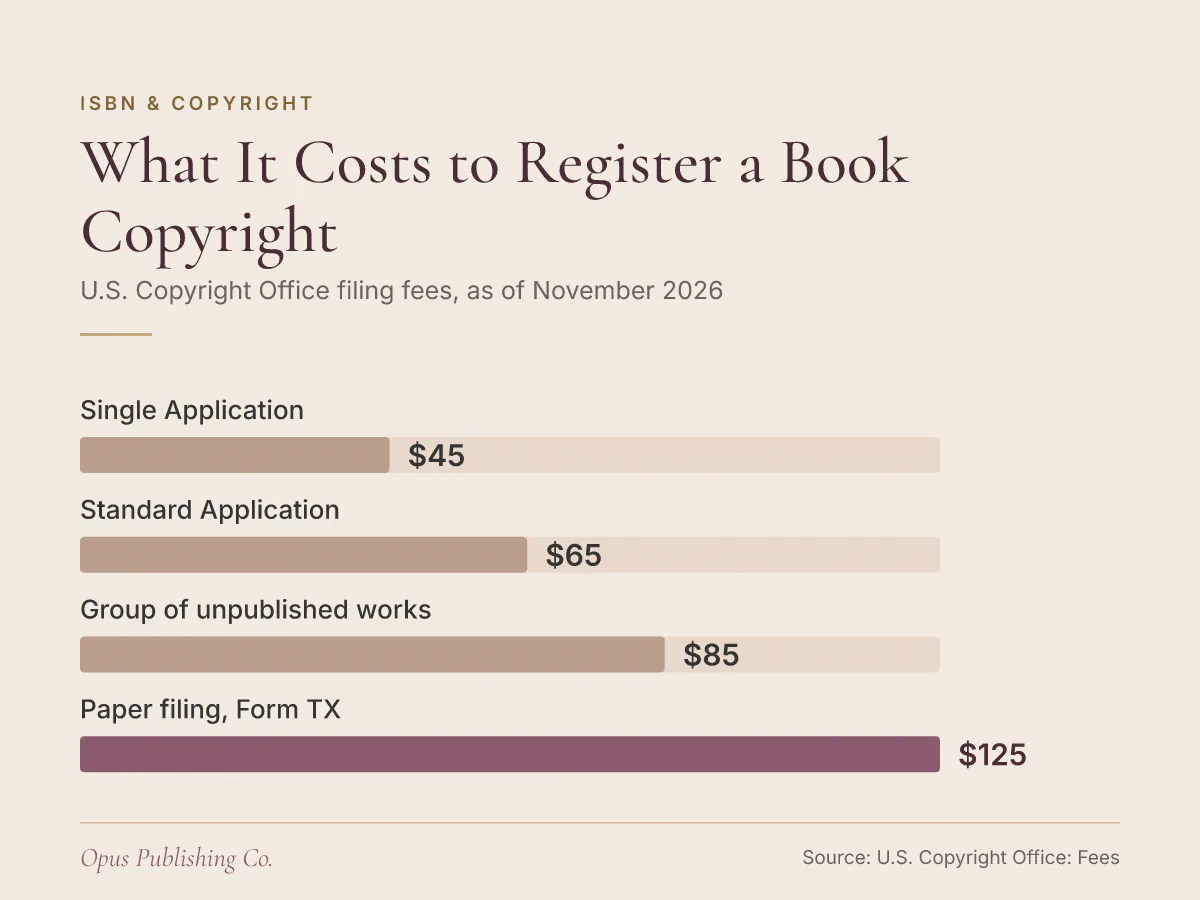
You finished the book and now you want it on record with the U.S. Copyright Office. To register copyright for a book in the US, you apply online under the Office's literary works category and pay a filing fee of $45 or $65, as of November 2026. The $45 Single Application is the restricted tier, the $65 Standard Application is the general one, and filing the same claim on paper with Form TX costs $125.
How do you register copyright for a book with the Copyright Office?
Registration runs through the U.S. Copyright Office's electronic system. You pick the application that matches your book, complete it, pay the filing fee, and send the Office a copy of the work. Start on the Office's literary works page rather than a filing service.
The Office's registration page for literary works is the hub for all of this. A literary work, in the Copyright Act's own words, is a work "expressed in words, numbers, or other verbal or numerical symbols or indicia" (17 U.S.C. section 101). The Office's list of works commonly registered in that category includes fiction and non-fiction books, autobiographies and memoirs, educational workbooks, and text with artwork included.
The order of work looks like this:
- Start on the Copyright Office's literary works page, which lists every registration option for a book in one place.
- Decide which application you qualify for. The literary works page lists the Standard Application, the Single Application, the group options, preregistration and supplementary registration.
- Preview the application before you start filling it in. The Office publishes a preview of the Standard Application for a literary work, plus walkthrough videos for the Standard Application, the Single Application and submitting your work.
- Complete the application, naming the author and the claimant. The claimant is whoever is named in the application as owning the copyright being registered.
- Pay the fee for your route and submit your work to the Office. The copy you send is the deposit copy, the copy the Office keeps with the registration.
Read the Office's "Update on Deposit Requirements" notice, which sits on the same literary works page, before you prepare the file you are going to upload. Deposit rules are the part of this process most likely to have changed since the last guide you read.
Paper is still possible. The paper forms for registration are Forms PA, SR, TX, VA and SE, and a literary work uses Form TX. It costs more, which the next section prices.
How much does it cost to register copyright for a book?
Registering one book costs $45 or $65 in filing fees as of November 2026, according to the Copyright Office's fee schedule. The $45 Single Application carries strict eligibility conditions. The $65 Standard Application is the general route for an original work of authorship.
Here is what the Copyright Office fee schedule lists for the routes an author is likely to use:
| Filing route | Fee | What the schedule says it covers |
|---|---|---|
| Single Application | $45 | Single author, same claimant, one work, not for hire |
| Standard Application | $65 | A claim in an original work of authorship |
| Group of unpublished works | $85 | A claim in a group of unpublished works |
| Group of short online literary works | $65 | A claim in a group of short online literary works |
| Paper filing, Form TX | $125 | Paper filing on Forms PA, SR, TX, VA and SE |
The spread between $45 and $125 is the same book, registered three different ways. That is the practical reason to spend ten minutes on the eligibility wording before you open an application: the cheapest route is also the most restricted one.
One thing the fee schedule does not price is an ISBN, because the two are unrelated systems. An ISBN is the retail identifier that bookstores and distributors use, not a filing with the Copyright Office. If you are still deciding whose ISBN to put on the book, free KDP ISBN versus your own covers that choice separately.
Should you file the Single Application or the Standard Application?
File the Single Application only when all four of the fee schedule's conditions hold: one author, that author as the only claimant, one work, and not for hire. Anything else, including a co-written or ghostwritten book, goes on the Standard Application at $65.
The four conditions, in plain terms:
- Single author. One human wrote it. A co-author, an illustrator credited as a co-author, or a second contributor whose work is part of the claim takes you out of this tier.
- Same claimant. The author and the owner being registered are the same party. Assign the rights to an LLC or a co-owner and the author and the claimant stop being the same party.
- One work. One book, on one application.
- Not for hire. The book was not created as a work made for hire, the category that applies when an employer or commissioning party stands in as the author. If your book was written under that kind of agreement, read the Office's guidance before picking a tier.
The gap between the two fees is small, and it is not worth a guess. If your situation is close to the line, the Standard Application covers it, and $65 is cheaper than finding the problem later. An electronic supplementary registration to correct a filing costs $100.
Say you wrote a children's book and hired an illustrator. Whether the illustrations are part of the claim, and whether that makes the work co-authored, changes which application fits. The Office's literary works category explicitly includes "text with artwork included", so the answer depends on what you are claiming and who created it. Work that out before you start the form, not halfway through it.
Can you register more than one book in one application?
Group registration is the Copyright Office's option for covering several works on one application. The literary works page lists groups for unpublished works, short online literary works, serial issues, contributions to periodicals, newspapers and updates to a news website. The fee schedule prices them separately from a single claim.
What the schedule charges, as of November 2026:
- Group of unpublished works: $85. The Office states that its old "Unpublished Collection" option has been replaced by the Group Registration Option for Unpublished Works, known as GRUW. Any guide still telling you to file an unpublished collection is out of date.
- Group of short online literary works: $65. Known as GRTX, and described by the Office as covering short online literary works such as blog entries, social media posts and short online articles.
- Group of serials: $35 per issue, with a minimum of two issues.
- Group of contributions to periodicals: $85.
- Group of newspapers, newsletters or updates to a news website: $95. The news website option is called GRNW.
For most authors with one finished book, none of these apply, and the filing is the Single or Standard Application. The group options matter if you have a drawer of unpublished manuscripts, a serialized story, or a body of short pieces published online under your name.
Formats are a separate question from registration. One manuscript released as a paperback, an ebook and an audiobook is one text, but the retail identifiers differ, which is what whether each format needs its own ISBN walks through.
What does it cost to fix a mistake after you register?
Corrections cost extra. The Copyright Office's fee schedule lists an electronic supplementary registration at $100 and a paper Form CA correction at $150. Correcting Public Catalog data after an erroneous electronic title submission costs $7 per title.
A supplementary registration is the filing that corrects or amplifies information in a registration that already exists. Electronically it costs $100, more than twice the $45 Single Application fee that may have carried the error. The $150 paper rate is narrower: Form CA covers corrections to renewal registrations, GATT registrations (claims in a restored copyright) and group registrations for non-photographic databases.
So treat the application as a document you proofread. Before you submit, check:
- The author name exactly as you want it to stand on a public record, including whether you are filing under a pen name.
- The claimant, and whether it should be you or a company.
- The title, spelled and punctuated as the published book is.
- The year of completion and, if the book is out, the publication details.
- Whether the work really qualifies for the tier you picked.
Two other lines in the schedule are worth knowing about. Voluntary cancellation of a registration costs $150. Removing personally identifiable information from a registration record costs $100 for an initial request, charged per registration record, with a flat $60 to have a denied request reconsidered. The Office runs an online Public Catalog of registration data, so decide what you are comfortable having in that record before you file, not after.
When would you pay for preregistration or special handling?
Rarely, and most authors never will. The Copyright Office's literary works page flags preregistration as restricted and not for the majority of applicants, and the fee schedule prices it at $200. A special handling fee for a claim is listed separately at $800.
The schedule does not spell out what special handling covers, so treat the Office's fee page as the place to check whether it could apply to you. The same schedule charges a $50 handling fee for each non-special-handling claim that uses the same deposit. A few other high-fee lines sit nearby, and knowing they are there stops you worrying that you have missed a step:
| Service | Fee |
|---|---|
| Preregistration of certain unpublished works | $200 |
| Special handling fee for a claim | $800 |
| Litigation statement, Form LS | $100 |
| Full-term retention of an electronic deposit | $220 |
| Full-term retention of a physical deposit | $540 |
None of those are part of registering a finished book. They sit at the edges of the system for unusual situations, and the fee page is the place to confirm whether one applies to you. The fee page also points to a separate fee study page that explains how the Office sets these fees. So check the current schedule on the day you file rather than trusting a figure from a blog, including the figures here once this post is a year old.
What to do before you file
Pick your application tier first, because everything else follows from it. Then settle the details that are expensive to change afterwards.
- Read the four Single Application conditions against your own book. One author, one claimant, one work, not for hire. If any of them wobble, budget $65 instead of $45.
- Decide the name question. Legal name or pen name on a public record, and whether the claimant is you or a company.
- Finalize the manuscript file you will deposit, and read the Office's deposit requirements update on the literary works page first.
- Set the money aside for the route you picked: $45 or $65 for a single book, $85 for a group of unpublished works, or $125 to file on paper.
- Save the completed application as a PDF for your records before you submit, so a later correction starts from what you actually filed.
If the registration is one item on a longer launch list, the sequencing with retailer setup matters too: metadata, categories and ISBN decisions all land in the same week. Opus's publishing and distribution work covers that side, including setup and metadata on Amazon KDP, while the copyright filing stays yours to make directly with the Office.