Most authors finish a draft with a short list of willing friends and a long list of worries about money, which is what the beta readers vs editor question is really about. Beta readers cannot replace a professional editor, because the two produce different information. Beta readers tell you where the reading experience broke for a real reader. An editor tells you which craft decision broke it and what to change on the page.
Can beta readers replace a professional editor?
Beta readers cannot replace a professional editor, because the two answer different questions. Beta readers answer how your book lands on a reader who is not you. An editor answers what caused that reaction and which revision fixes it.
Both halves matter, and neither half is optional if you plan to sell the book. A reader who says the middle dragged has given you real evidence. What they usually cannot give you is the cause: a subplot that resolves too early, three chapters in a row of the same scene shape, or a protagonist who stops wanting anything once the book is half over.
Run the comparison the other way and the asymmetry is just as sharp. An editor cannot give you an unguided first-time reaction to your book, because an editor who works in your genre is no longer an ordinary reader of it. They notice structure the way a builder notices a sagging roofline. That trained eye is exactly what you are paying for, and it is also why their surprise is not the same as a reader's surprise.
So treat the two as different instruments. Beta readers measure the reading experience. An editor diagnoses and prescribes.
What do beta readers actually catch?
Beta readers catch reactions: boredom, confusion, disbelief, and the moment they stopped caring. Volunteer readers are reliable about where the experience broke and unreliable about why it broke.
Knowing which half of that is trustworthy is what makes a good brief. A beta reader is a target reader who agrees to read an unpublished draft and report back. Expect them to be strong on these:
- Pace. Where they skimmed, where they put the book down, where they wanted to keep going.
- Clarity. Which characters they mixed up, which rules of your world they never understood, which timeline jumps lost them.
- Belief. The decision a character made that felt out of character, the coincidence that felt convenient.
- Satisfaction. Whether the ending paid off the promise of the opening.
- Genre fit. Whether the book delivered what readers of your genre showed up for.
Three structural limits apply no matter how generous your readers are. Volunteer readers do not read a second time against their own notes, so nobody checks whether your revision worked. They keep no written record of your spelling and style choices, so your inconsistencies survive. And they stop at the first thing they notice, which means a strong reaction to chapter two often hides a quieter problem in chapter nine.
What does a professional editor catch that beta readers miss?
A professional editor catches cause, pattern and consistency: the craft decision behind a reader's reaction, the habit repeating across the book, and the small choices that have to match. Editors work in defined passes, so each problem is fixed at the stage where it costs least.
Three passes do different work, and the names matter when you ask for a quote. A developmental edit works on story: structure, plot logic, point of view, pace and character arc, meaning the way a character changes across the book. A line edit works on the prose: rhythm, clarity, repetition and the way each paragraph moves. A copy edit works on correctness and consistency: grammar, usage, continuity and a style sheet that records every decision made about your book. If you are not sure which one your draft needs, our guide to developmental, line and copy editing separates them by the problems they solve.
The style sheet is the clearest example of what volunteer feedback cannot produce. An editorial style sheet is a document listing your book's choices: whether the sisters are the Hallorans or the Halorans, whether numbers are spelled out, how your invented words are hyphenated, what color each character's eyes were in chapter one. Readers notice an inconsistency. Editors prevent the next one.
Editors also push back with their reasons visible, which is harder for a friend to do. Say you have a 70,000-word debut and the opening three chapters are backstory. A beta reader is likely to say the start was slow. An editor will tell you the inciting incident, the event that sets the story in motion, does not arrive until chapter four, and show you which backstory to move or cut.
Beta readers vs editor: which feedback comes first?
Send the draft to beta readers after your own revision and before you pay for editing, with one exception. Beta feedback tends to trigger structural rewrites, and you do not want to pay for polished sentences that a rewrite will delete.
A workable production order for most independent authors:
- Finish the draft, then revise it yourself. Our self-editing checklist covers the passes worth running before anyone else reads it.
- Send it to beta readers with a short, specific question list.
- Revise on the patterns in their feedback, not on every individual comment.
- Book the edit the revised draft actually needs.
- Keep a final proofread, the last check for typos and layout errors, until after formatting, so late changes get checked.
The exception is a draft you already know is structurally broken. If you finished the book and cannot tell whether the plot holds together, beta readers will confirm the pain without locating the fracture, and you will spend a round of goodwill to learn something you already suspected. In that case a developmental edit first is the better buy, and beta readers become your check on whether the rewrite worked.
One more ordering mistake is worth naming: do not send a messy draft to readers hoping they will be tolerant. Typos and formatting noise pull attention to the surface, and surface notes are the least valuable thing a reader can give you.
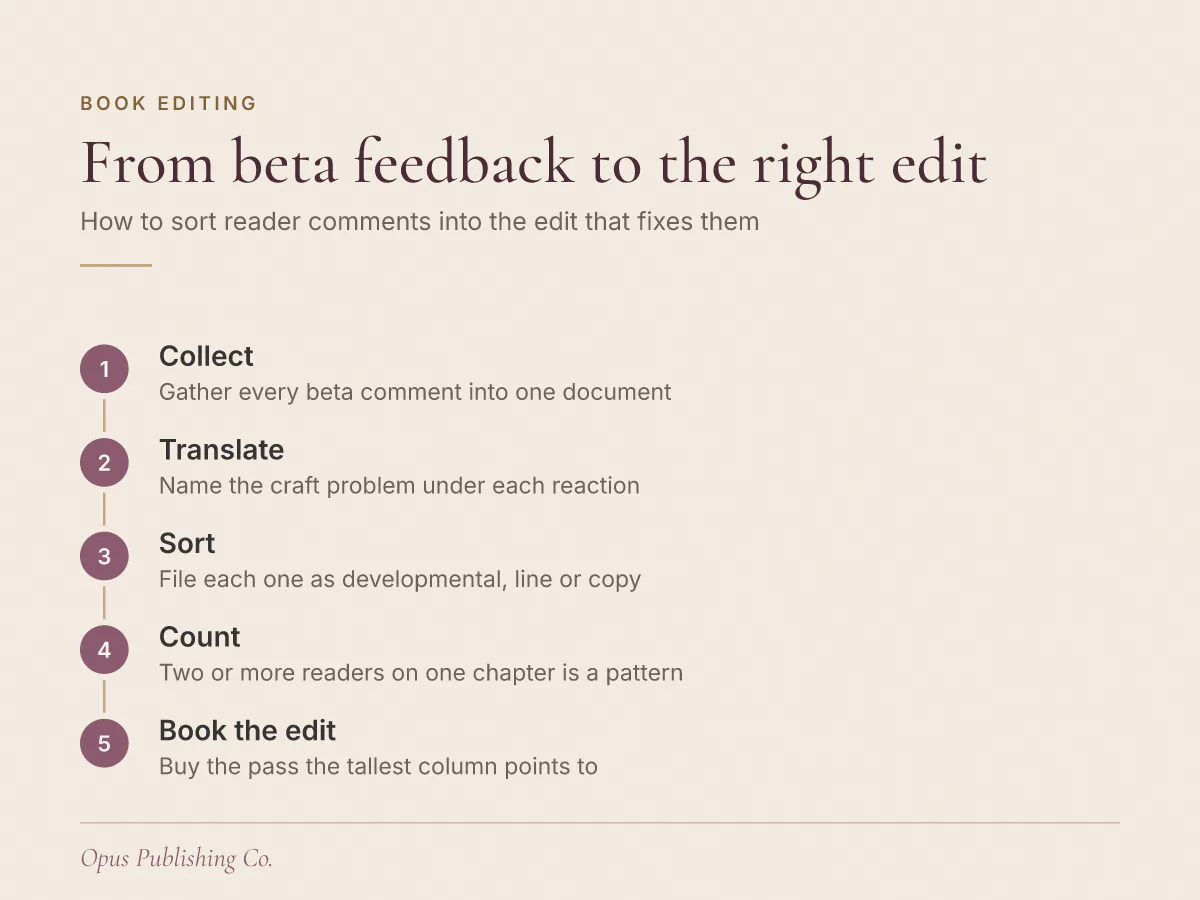
How do you turn beta reader feedback into the right edit?
Translate each comment into the craft problem underneath it, then count. Beta readers report symptoms in the language of experience, and almost every symptom maps to one of three edits. Two readers flagging the same chapter is a pattern worth acting on.
The phrasings below are typical of beta feedback, not quotes from any particular reader.
| What a beta reader says | What is probably happening | The edit that fixes it |
|---|---|---|
| "I skimmed the middle." | Stalled plot, repeated scene shapes, stakes that stop rising | Developmental edit |
| "I could not keep the sisters apart." | Characters without distinct voices or goals | Developmental edit |
| "I did not believe she would do that." | Motivation built off the page, or an arc with a step missing | Developmental edit |
| "It took me a while to get into it." | Slow opening, late inciting incident, front-loaded backstory | Developmental edit |
| "It felt wordy, but I cannot say where." | Padded sentences, filter words, flat rhythm | Line edit |
| "Something about the dialogue felt off." | Uniform speech patterns, over-tagged lines | Line edit |
| "I kept noticing small mistakes." | Grammar, usage and continuity errors | Copy edit |
| "Her eyes changed color." | Inconsistent detail with no style sheet behind it | Copy edit |
Two rules keep this honest. First, weigh patterns over opinions: one reader disliking your prologue is taste, and three readers skimming it is a structural problem. Second, never ask a beta reader to diagnose. Ask what happened while they read, not what you should change, because the moment a volunteer starts prescribing fixes you get their taste in exchange for your evidence.
If two columns fill up, start with the leftmost. Story fixes rewrite sentences anyway, while a line edit never repairs a plot.
How many beta readers do you need, and what should you ask them?
Recruit more readers than you need, because some will not finish, and plan on at least three who do. One reader's reaction is an anecdote. Three overlapping reactions are a pattern you can act on without guessing.
Choose readers who already read your genre. A thriller reader and a literary fiction reader will disagree about pace, and only one of them is your audience. Avoid anyone who cannot tell you something unwelcome.
Give each reader a short question list, sent with the draft:
- Where did you stop reading, and why did you stop there?
- Which parts did you skim or skip?
- Was there anything you did not understand, or had to reread?
- Which character did you care about most, and which least?
- Did any character act in a way you did not believe?
- Did the ending deliver what the opening promised?
- Would you recommend this book to someone who reads this genre, and how would you describe it to them?
Ask for the reading experience and nothing more. Questions such as "what would you change" invite rewriting by committee, and a volunteer reader has no obligation to be right about solutions.
What to do this week
Pick the case that matches the draft on your desk, then take the action next to it this week.
- Your draft is finished and self-edited. Recruit readers in your genre, send the draft with the seven questions above, and give everyone the same deadline.
- Beta feedback is already sitting in your inbox. Sort every comment into the developmental, line or copy column, count the entries, and book the edit the tallest column points to.
- You cannot tell whether the story works at all. Buy a story-level read before you spend anything on sentences. A structural problem caught after a line edit means paying twice for the same paragraphs.
Either way, write your questions before you send anything out. The quality of beta feedback depends more on the question list than on the readers.